
Table of Contents
ToggleISO 14644 Cleanroom Classifications: A Complete Guide to Cleanroom Standards
Choosing a cleanroom classification is one of the earliest decisions in a controlled environment project, and one of the most expensive to get wrong. Specify a class tighter than your process needs and you pay for it every month in air handling, filtration, and gowning. Specify one too loose and you find out during validation, after the walls are up. Here is what the standard covers, what each class allows, and how to match one to your application.
What Is ISO 14644 and Why It Matters
ISO 14644 is the international standard for cleanrooms. Part 1 is the one people usually mean, and it classifies a room by a single measurable thing: how many airborne particles of a given size are allowed in a cubic meter of air. Temperature, humidity, pressure, and air change rate are all specified separately, based on your process. For example, if moisture has an impact on your product, your room can hold its particle class perfectly and still fail your process if the humidity drifts.
The current version, ISO 14644-1:2015, replaced the older US federal standard that produced the Class 100 and Class 10,000 labels still used on plant floors today. If you are working from a specification written before 2015, three changes matter: the 5 micron limit was dropped from the ISO 5 class, sampling locations are now judged independently of one another, and particle counters must be calibrated to a specific standard, ISO 21501-4.
ISO Cleanroom Classes Explained (ISO 1 through ISO 9)
There are nine classes. ISO 1 is the cleanest, ISO 9 is close to ordinary filtered room air. Each step down the scale allows ten times fewer particles, so moving from ISO 7 to ISO 6 is not a small adjustment. It is a tenfold change, and the mechanical system has to be built for it.
ISO Class | Max particles per cubic meter (0.5 um and larger) | Old US equivalent | Typical use |
ISO 1 | Not specified at this size | – | Advanced semiconductor, nanotechnology |
ISO 2 | 4 | – | Specialized research |
ISO 3 | 35 | Class 1 | Semiconductor fabrication |
ISO 4 | 352 | Class 10 | Precision optics, microelectronics |
ISO 5 | 3,520 | Class 100 | Aseptic filling, implantable devices |
ISO 6 | 35,200 | Class 1,000 | Medical device, electronics assembly |
ISO 7 | 352,000 | Class 10,000 | Controlled assembly and packaging |
ISO 8 | 3,520,000 | Class 100,000 | Gowning, staging, general assembly |
ISO 9 | 35,200,000 | – | Controlled warehousing and support |
The standard sets limits at other particle sizes too, from 0.1 to 5 microns, but the 0.5 micron column above is what most specifications are written around. ISO 5, still widely called Class 100, is the workhorse for critical manufacturing. AVM Group built a Class 100 ballroom-style cleanroom for Swagelok’s precision fittings operation.
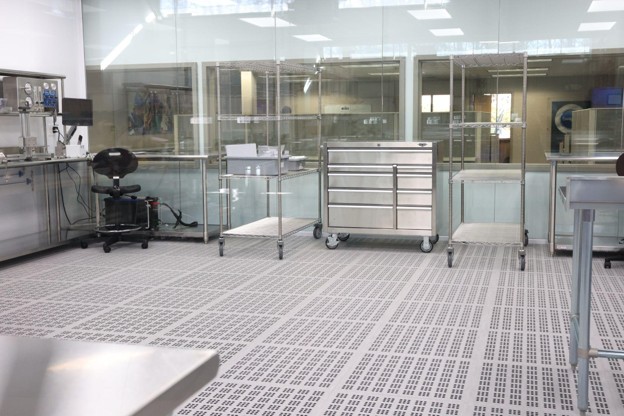
Well-designed facilities usually combine several classes rather than picking one. A typical layout steps from ISO 8 at the entrance down to ISO 5 at the critical process, with air pressure differences between zones so that dirtier air never moves toward cleaner air.
How Cleanroom Classifications Are Measured and Certified
Classification is a measurement exercise with specific rules, not a general impression of cleanliness. A particle counter samples air at set locations throughout the room, the number of locations depends on the floor area, and each location is judged on its own.
Occupancy state matters as much as the number, and this is where specifications most often go wrong. The standard recognizes three states:

As-Built
meaning the room is finished but empty

At-Rest
meaning equipment is installed and running with nobody inside

Operational
meaning staff are doing normal work
A room that holds ISO 5 at rest may run at ISO 7 operationally, which is completely normal. A class specified without naming which state is incomplete, because that one word changes the mechanical design significantly.
Commissioning also covers airflow readings, filter integrity testing, pressure verification, and a recovery test measuring how fast the room returns to its class after a deliberate particle challenge. The most common cause of certification delay is not a mechanical shortfall, though. It is a specification that was never fully defined before construction, then read differently by the designer, the installer, and the certifying agency.
Choosing the Right Cleanroom Class for Your Application
The right class is the one your process requires, checked against the regulations that govern your industry. Cleaner is not better. Every step cleaner permanently raises air change rates, filtration, mechanical capacity, gowning burden, and operating cost.
Start with product exposure. How long is the product open to room air, and what happens if a particle lands on it? A component exposed for seconds inside an enclosed machine has a very different requirement from a device assembled by hand over several minutes. Then account for your own process as a particle source, since people are the largest contributor in most rooms, and equipment and material transfer add more.
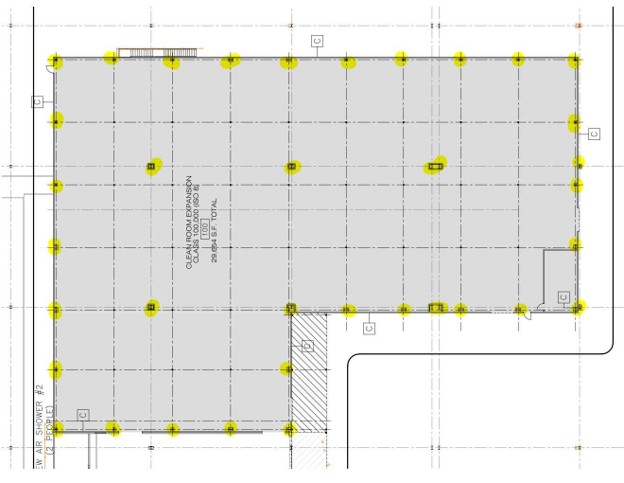
Finally, think in zones rather than one uniform space “class”. Applying your strictest requirement to the whole footprint is a common and costly mistake. An ISO 5 zone around the critical operation, surrounded by ISO 7 and ISO 8 support space, delivers protection where it counts at a fraction of the lifetime operating cost. The MatterGuard Product Specifier is a quick way to get your requirements in front of our product team.
How AVM Group Designs and Builds to ISO 14644 Standards
Since 1983, AVM Group has designed, engineered, manufactured, and installed controlled environments for semiconductor, pharmaceutical, medical device, aerospace, and research clients. Our MatterGuard cleanrooms are hardwall systems modularly built around your classification requirement, your equipment layout, and the real conditions of your building, rather than fitted to a catalog layout.
The classification target drives the design from the first meeting. Airflow, pressure relationships, equipment heat loads, cleaning routines, and material compatibility get worked out together, because they affect one another. Wall, ceiling, and flooring materials are chosen to be non-shedding and cleanable based on your class, chemical exposure, and cleaning frequency. The envelope, mechanical systems, and controls are treated as one system.
Validation requirements are addressed during design rather than discovered afterward, so certification follows the build with minimal field changes. One last note: if your process is sensitive to moisture as well as particles, a cleanroom class alone will not cover it. Ultra-low humidity work belongs in a dry room, where dew point rather than particle count is the controlling variable.
To settle the right classification before budgets are set, contact AVM Group or call (216) 241-2255. Our sales team and engineers will walk you through design and budgeting, and your quote comes at no cost.