Table of Contents
ToggleLithium-Ion Battery Dry Rooms: Design and Specification Guide
Lithium-ion cell production does not tolerate moisture. Water reacts with battery electrolyte to form acid that degrades capacity, shortens cycle life, and can create safety risks in the finished cell. That is why battery manufacturing requires dry rooms held far drier than any ordinary industrial spaces or cleanrooms. Here is what those rooms need to achieve, which specifications drive the design, and where dry room projects typically fail.
Why Dry Rooms Are Critical for Lithium-Ion Battery Manufacturing
The core challenge is chemical reaction. The lithium salt used in most battery electrolytes (such as LiPF₆)〖LiPF〗_6 reacts with water vapor to produce hydrofluoric acid (HF), which attacks the internal components of the cell. The damage rarely causes immediate failure during testing; instead, it manifests as capacity fade, higher internal resistance, and inconsistent cycle life across a production lot. This results in costly field product recalls.
Several battery manufacturing and production steps are particularly vulnerable to moisture contamination:
- Post-drying electrode handling
- Cell stacking and winding
- Electrolyte filling
- Final cell sealing
Electrolyte filling is usually the most demanding point on the assembly line. It is common for that station alone to require significantly drier supply air than the surrounding room environment.
A dry room is not a cleanroom, and treating them as the same thing causes severe specification errors. A cleanroom controls airborne particulate matter, whereas a dry room controls water vapor. Battery manufacturing facilities often need both, and the two can pull against each other, since increased airflow to control particles introduces additional moisture that must be removed. (If your project has a particulate classification, consult our guide to ISO 14644 cleanroom classifications.)
Key Dry Room Specifications: Dew Point, Relative Humidity, Air Changes
Dew point is the single most critical specification during dry room design. Relative humidity (%RH) fluctuates with temperature, making it an ambiguous metric on its own. Dew point defines how much water vapor is in the air, which is the dependent variable driving chemical degradation. Always specify the dew point, state the operating temperature alongside it, and treat relative humidity as a secondary metric.
In lithium-ion manufacturing, minus 40 degrees Celsius dew point (roughly 1% RH at room temperature) has become the common baseline for cell production. Real requirements range from about minus 30 to minus 60, and at critical stations the incoming air can be specified as low as minus 80. Newer chemistries are trending drier still, so it is worth designing with some headroom.
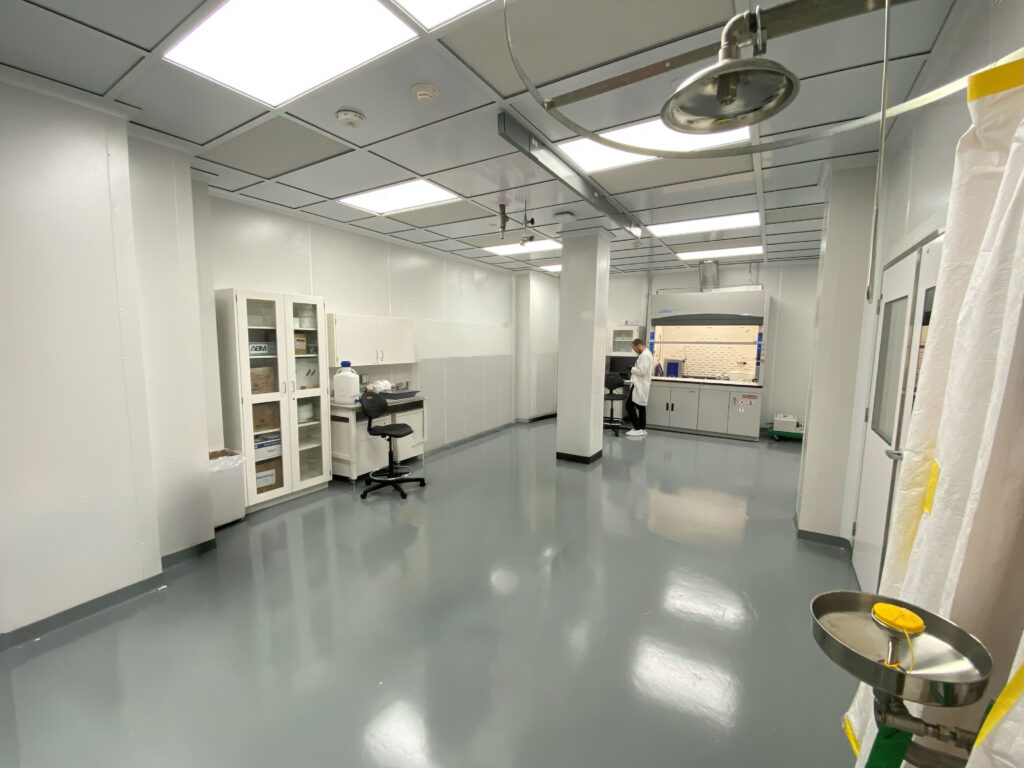
In lithium battery applications, the MatterGuard Dry Room achieves minus 40 degrees Celsius dew point at the return, with more tailored solutions achieving up to minus 80 degrees Celsius dew point when required, and uses fully self-contained and vapor-tight structures. Most custom rooms operate between minus 20 and minus 60 degrees Celsius dew points.
Designing for lower dew points than is necessary adds significant capital cost and operational complexity without improving yield. Air change rate (ACH) is the third specification criteria: zones that also need particle control are often designed for more than 50 air changes per hour, and every air movement cycle introduces moisture load that the HVAC equipment must remove.
Common Dry Room Failures in Battery Production
Most dry room failures trace back to two root causes: envelope infiltration (air leaking in), and load miscalculation (moisture load that was underestimated). Air leaks at doors, penetrations, and wall joints/transitions add water vapor faster than the desiccant systems can remove it. Additionally, sizing HVAC equipment based strictly on room volume rather than operational heat and moisture loads yields a system that maintains spec when empty, but drifts out of tolerance as soon as personnel and machinery enter.
Moisture Load Sources
Personnel Load
Envelope Leaks
Process Air Intake
Material Ingress
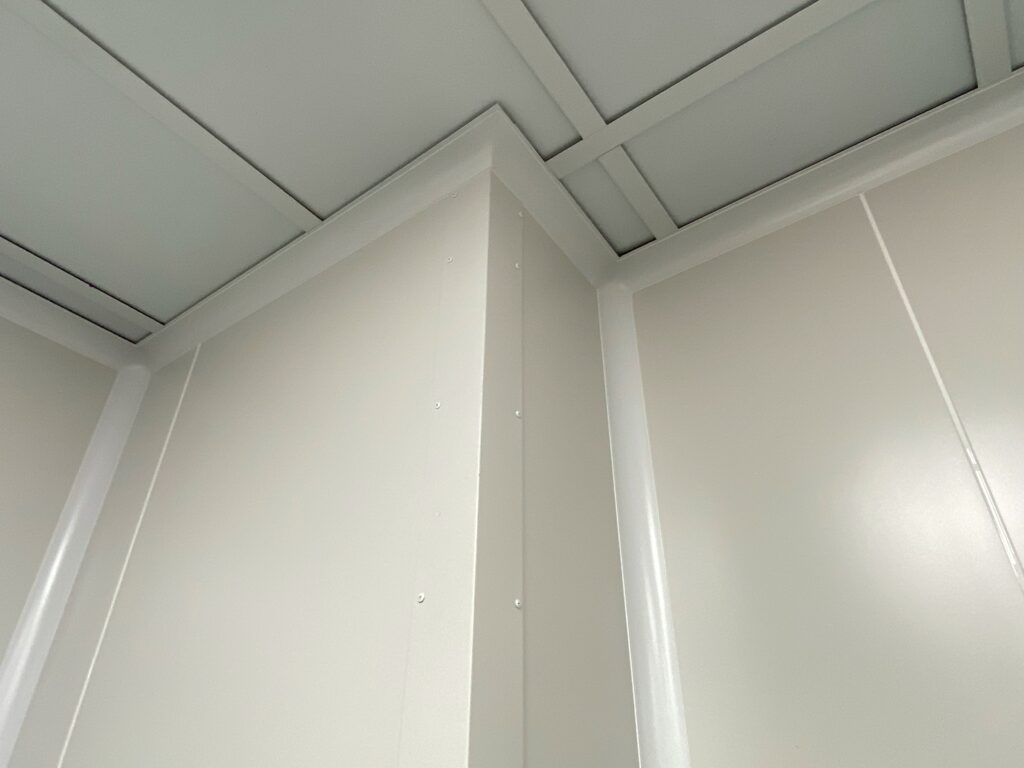
To prevent envelope failure, the containment shell must be designed as a continuous vapor barrier. Walls, ceiling panels, floor connections, door frames, and every utility penetration (conduit, piping, ductwork) must be sealed as a unified system. Field-improvised seals around penetrations account for the vast majority of humidity leaks.
Moisture load calculations must incorporate all active sources. People are usually the largest contributor, so headcount and shift pattern matter, and incoming material and air leakage add more. Doors deserve particular attention, since they are both the largest moisture pathway and the thing operators use hundreds of times a shift.
- Personnel: Headcount, activity level, and shift handover patterns represent the largest transient moisture load.
- Door Openings: Main entryways and pass-through airlocks are primary air exchange pathways used hundreds of times per shift.
- Raw Materials: Hygroscopic components introduced into the space bring trapped ambient moisture.
Improper load sizing causes operational instability. Undersized systems allow humidity levels to drift during peak production, while oversized systems cycle on and off continuously, causing wide temperature and dew point swings.
Environmental Controls and Equipment for Battery Dry Rooms
The MatterGuard dry room consists of three integrated systems: the structural envelope, the mechanical systems, and the controls. Treating any one as a separate vendor or contractor scope often leads to mismatched equipment that fails to hold ambient targets.
MatterGuard
- Vapor-tight joints
- Sealed pass-through
- Airlock integration
Mechanical Systems
- Desiccant dehumidifiers
- Chillers & condensing
- Process exhaust makeup
MatterLogic
- Internal sensor network
- Active load response
- Real-time audit log
Mechanical Systems: Industrial desiccant dehumidifiers perform primary moisture removal, as mechanical cooling alone cannot achieve dew points below freezing (-40°C to -80°C). Condensing units, chillers, and exhaust blowers manage room temperature and process air makeup. Equipment is sized directly against real-world latent loads and ambient facility interactions, not by simply the room size.
Control Architecture: MatterLogic controls provide the programmable logic required to maintain stability under fluctuating room conditions. Continuous monitoring with environmental sensors positioned inside the working space versus relying solely on supply-duct readings means that MatterLogic detects infiltration leaks and shift-change load surges in real time. Continuous data logging provides audit trails and triggers early warning alarms before product quality is compromised.
Partner with AVM Group for Your Battery Dry Room Project
AVM Group designs, builds, installs, and services custom dry rooms tailored to ultra-low dew point applications. Beyond high-volume lithium-ion cell production and R&D, our engineering teams build specialized dry rooms for pyrotechnic material handling, moisture-sensitive pharmaceutical synthesis, micro-LED optics assembly, and advanced energy research. Our client portfolio includes leaders such as ASML, Blue Origin, DuPont, Kairos Power, and Lockheed Martin.
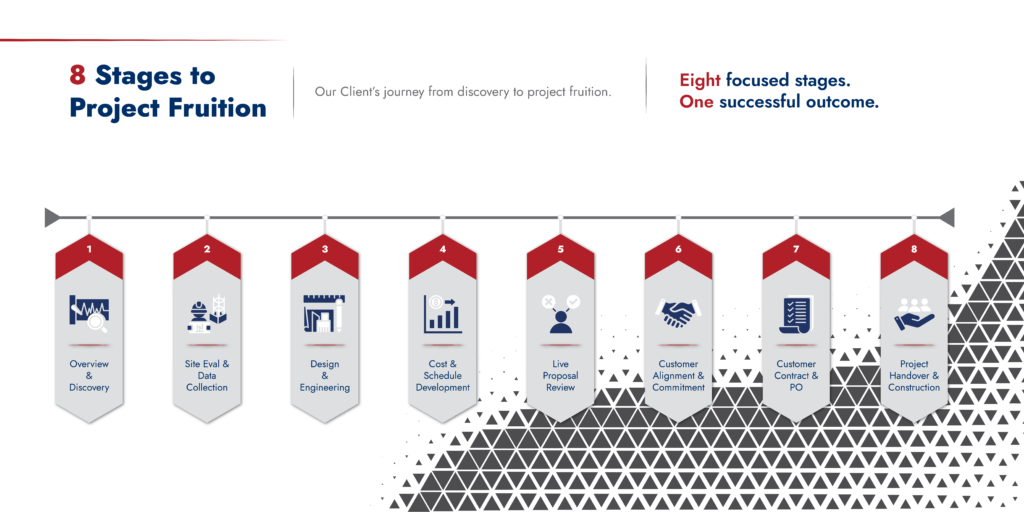
We execute projects through an 8-stage structured model to ensure systems are fully engineered before pricing commitments are made:
Stage 1: Overview & Discovery
Initial consultation to align on facility scope, application parameters, and operational goals.
Stage 2: Site Evaluation & Technical Data Collection
In-depth analysis of facility constraints, internal heat loads, headcount, shift patterns, and target dew points.
Stage 3: Conceptual Design & Engineering Review
Modeling room geometry, airflow distribution, envelope sealing, and desiccant capacity.
Stage 4: Project Estimate & Schedule Development
Sizing mechanical hardware and building a detailed milestone timeline based on actual moisture loads.
Stage 5: Live Proposal Review
Collaborative review of the engineered scope, equipment specifications, and project cost.
Stage 6: Project Alignment & Customer Commitment
Refining technical details to match stakeholder expectations and securing formal alignment.
Stage 7: Contract Terms Finalized
Finalizing commercial agreements, procurement schedules, and delivery parameters.
Stage 8: Project Kickoff & Construction
Turnkey procurement, off-site fabrication, site integration, installation, and commissioning.
Get Started Today
To get started, the MatterGuard Product Specifier puts your requirements in front of our team, or contact AVM Group at (216) 241-2255. Your quote comes at no cost.